
On this page
- What lands in Decatur gutters?
- Which type of guard fits which problem?
- Why does micro-mesh suit Decatur?
- What does a good installation look like?
- Do guards suit every house?
- What do guards cost?
- What maintenance do guards still need?
- How do guards handle summer storms?
- What about historic houses?
- What should be done before guards go on?
- How long do guards last?
- Which parts come up in a guard quote?
What lands in Decatur gutters?
| Debris | When | What it does |
|---|---|---|
| Oak leaves | Late October to December | Fill the trough in a few weeks and pack outlets |
| Oak catkins and pollen | March to May | Mat into a felt that slows water through mesh |
| Acorns | Late summer and autumn | Roll into outlets and jam downspout elbows |
| Sweetgum balls | Autumn and winter | Wedge in elbows and coarse screen holes |
| Pine needles | All year, more after wind | Slip through screens and mat with leaves |
| Shingle grit | All year, more on older roofs | Builds up as sediment at the outlets |
Decatur's canopy reached 57 percent cover in a 2019 assessment, most of it on residential lots, and the city's tree canopy conservation ordinance tightened rules on removing healthy trees from March 2022. The trees aren't going anywhere, so guards and cleaning are what keep gutters working.
Which type of guard fits which problem?
| Guard | Stops | Lets through | Under oaks |
|---|---|---|---|
| Stainless micro-mesh | Leaves, catkins, acorns, most pollen and grit | Water | Works well; brush off after catkin season |
| Reverse-curve hood | Whole leaves | Catkins and pollen ride the water inside | Leaves shed, but the hidden trough still fills |
| Screen | Whole leaves | Catkins, needles, pollen, seeds | Catkins drape and plug the holes |
| Foam or brush insert | Large leaves at first | Fines that pack the insert | Poor; sprouts seedlings |
Why does micro-mesh suit Decatur?
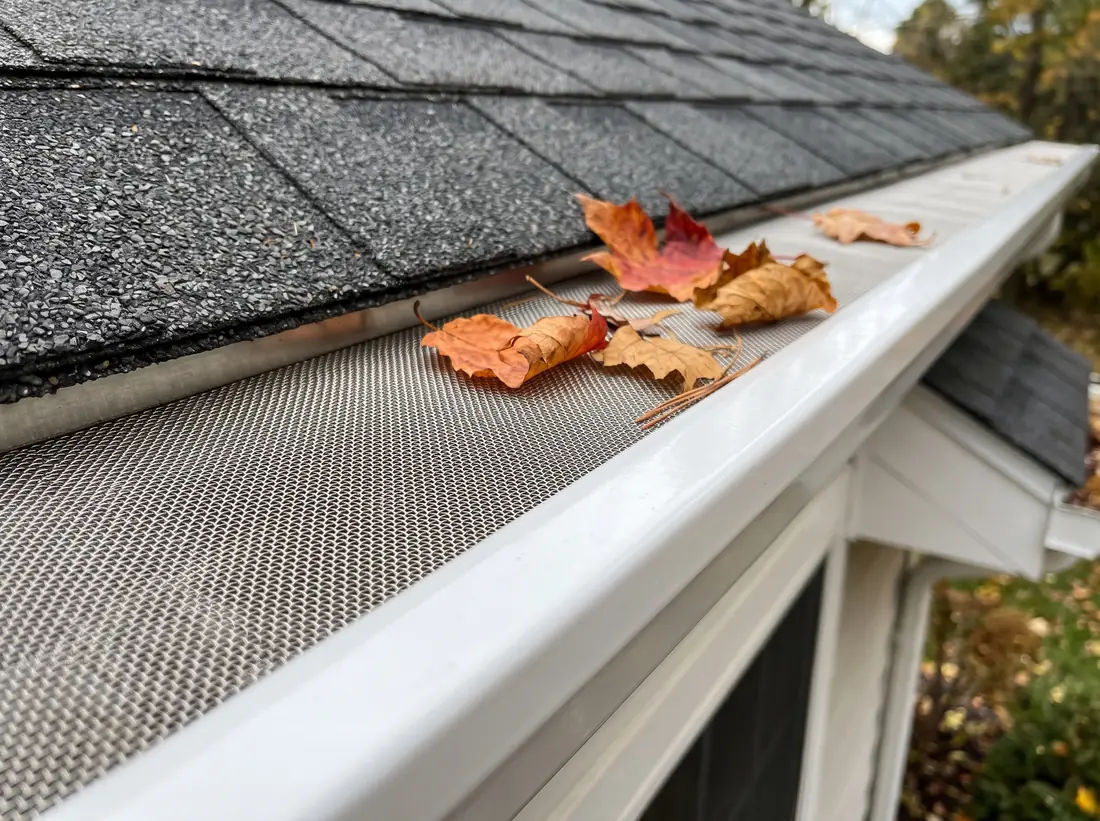
Fine stainless mesh has holes small enough to stop the stringy oak catkins that pass through screens, and a rigid frame that holds its shape under wet leaves and falling acorns. Debris sits on top, where wind and rain move most of it off, and where it can be brushed away without opening the gutter. Water passes through by surface tension even in heavy rain.
What does a good installation look like?
- The gutters are cleaned, flushed and checked before anything goes on.
- Loose hangers are replaced and low spots corrected, so water reaches the outlets.
- The guard fastens to the gutter lip and the fascia or drip edge, not under the shingles unless the roof allows it.
- Corners, valleys and end caps are trimmed and sealed so nothing gets in at the joints.
- Downspouts are upsized to 3x4 where the roof needs it.
Do guards suit every house?
They make most sense where:
- Oaks, pines or sweetgums overhang the roof.
- The gutters need cleaning more than once a year.
- The house is tall, steep or on a slope, making cleaning risky or costly.
- Overflow has already damaged fascia or soaked a crawl space.
They make less sense where few trees reach the roof, or where the gutters themselves are failing and due for replacement. Fix the gutters first. The are guards worth it guide weighs the cost.
What do guards cost?
Prices vary widely by type and brand. Expect stainless micro-mesh fitted by a contractor to add a substantial per-foot amount to the job, and screens and inserts to cost much less up front but more in cleaning over time. Ask for a quote that names the mesh material, frame, fastening method, and whether cleaning and repairs are included.
What maintenance do guards still need?
- A brush-off after catkin and pollen season in late spring.
- A look after leaf drop in December.
- A downspout flush every year or two.
- A check after big storms for limbs or debris on the guard.
The cleaning page and the oak trees guide cover the timing.
How do guards handle summer storms?
The heaviest summer bursts test any gutter. With guards, the weak points are valleys, where water arrives fast and concentrated, and very steep roofs, where water can overshoot. Diverters below valleys, 6-inch gutters on big roof planes and enough 3x4 downspouts keep a guarded system working when an inch of rain falls in under an hour.
What about historic houses?
Most guards sit at or below the gutter's front lip and are barely visible from the street. On half-round gutters, guards made for the round profile are available. If the house is in one of Decatur's local historic districts, it is worth asking the city whether anything visible on the front of the house needs review.
What should be done before guards go on?
Guards only help gutters that already work. Before fitting them, the gutters should be cleaned, every downspout flushed, loose hangers replaced, leaking joints resealed and low spots corrected so water reaches the outlets. If the fascia or rafter tails are soft, or the gutter is too small, fix that first. A guard on a sagging, leaking gutter keeps debris out but leaves the real problem in place.
How long do guards last?
Stainless micro-mesh on an aluminum frame is designed to last many years, often as long as the gutter. Plastic screens become brittle in the sun, and foam and brush inserts clog and need replacing much sooner. Ask what the mesh and frame are made of and how the guard fastens before comparing prices.
Which parts come up in a guard quote?
- The guard type, mesh material and frame.
- How it fastens, and whether it goes under the shingles.
- Whether the gutters are cleaned, repaired and resloped first.
- How corners, valleys and end caps are handled.
- Any downspout upsizing.
- What upkeep is recommended.
How do you check a gutter contractor in Georgia?
Start with the state rules. Georgia's State Licensing Board for Residential and General Contractors requires a license for residential work worth more than $2,500, though some specialty work falls outside it, so ask the contractor which rule covers your job and check any license number on the Secretary of State's verification lookup. Ask for proof of liability coverage and the addresses of a few recent jobs in Decatur or elsewhere in DeKalb County. Get a written quote that names the gutter size, metal and thickness, color, hanger type and spacing, the number and size of downspouts, where each one drains, and who hauls the old gutters away. If the house sits in one of Decatur's five local historic districts, exterior work generally needs a Certificate of Appropriateness from the Historic Preservation Commission before a building permit is issued, so ask whether the job needs one before a date is set.