
On this page
- What does a new installation include?
- Which gutter suits a Decatur house?
- How should gutters be sized for Decatur rain?
- How should gutters be fixed to old houses?
- What happens at the roof edge?
- Where should the water go?
- What do the rules say?
- What does installation cost?
- What belongs in a written gutter quote?
What does a new installation include?
A complete installation covers everything from the roof edge to the ground:
- Measuring every eave, including porch roofs, dormers and additions, and planning where outlets and downspouts go.
- Checking the roof edge: drip edge, gutter apron, and the condition of the fascia and rafter tails behind the old gutter.
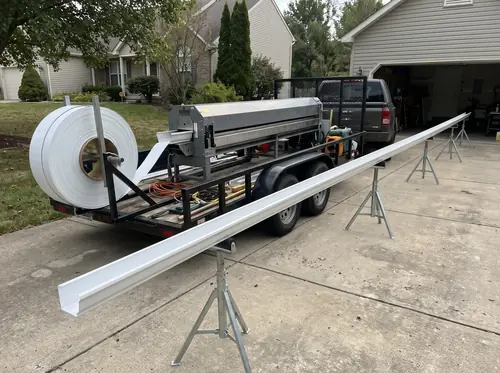
- Forming seamless runs at the house from coil, cut to the exact length of each wall.
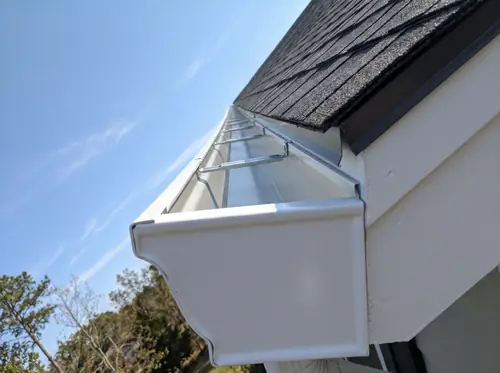
- Hanging the gutter on hidden hangers, or on brackets for half-round, at a slight slope toward each outlet.
- Cutting and sealing corners, end caps and outlets.
- Fitting downspouts with elbows and straps, and deciding where each one empties.
- Taking away the old gutters and cleaning up.
Which gutter suits a Decatur house?
| Gutter | Best for | Notes |
|---|---|---|
| Seamless aluminum, 5-inch | Bungalows, cottages and ranches | The usual choice: light, rust-free, many colors |
| 6-inch K-style | Two-story roofs, steep pitches, valleys, heavy trees | About 40 percent more capacity; pairs with 3x4 downspouts |
| Seamless steel | Houses under big oak limbs | Stiffer and harder to dent; the coating must stay intact |
| Copper | Historic and high-end houses | Very long-lived; weathers to brown and then green |
| Half-round | Victorian, Craftsman and Tudor houses | A traditional look on brackets; less capacity than K-style |
The seamless gutters page explains why most new gutters are formed on site rather than joined from stock lengths.
How should gutters be sized for Decatur rain?
The 1991 to 2020 normals for nearby Atlanta, as listed on Wikipedia, add up to about 50 inches of precipitation a year, and every month gets at least a few inches. July is the wettest at about 4.75 inches and October the driest at about 3.3. The real test for a gutter is how fast the rain comes. Summer thunderstorms can drop an inch or more in under an hour, and tropical remnants rain for days: Atlanta logged 11.12 inches in 48 hours as Helene passed in September 2024.
So gutters here need to move a lot of water quickly. Width, the number of outlets and the size of each downspout all matter as much as the metal.
Choose 6-inch when: - The roof is large or steep, or a valley empties into one short stretch of gutter. - An upper roof drains onto a porch roof that then drains into one gutter. - Oaks or pines overhang the roof, so debris builds up between cleanings. - A run is long and can't be given a second outlet.
The 5-inch vs 6-inch guide walks through the decision.
How should gutters be fixed to old houses?
Hidden hangers clip into the front lip of a K-style gutter and screw through the back into the fascia, ideally reaching the rafter tails behind it. About 2 feet apart is common, closer at corners and under trees, where a run packed with wet oak leaves weighs far more than one full of water. Screws hold where old spikes work loose.
Many Decatur bungalows have exposed rafter tails and thin fascia boards. On those, the contractor checks each tail for rot, replaces soft sections, and sometimes adds a backer board so every hanger has solid wood behind it. Half-round gutters hang from brackets screwed into the fascia or strapped to the roof deck.
The slope is usually about a quarter inch for every 10 feet. Long walls are often pitched from the middle toward outlets at both ends, which halves the distance water has to travel in a downpour.
What happens at the roof edge?
A drip edge or gutter apron under the first course of shingles sends water into the trough instead of letting it run behind the gutter onto the fascia. Plenty of older roofs in Decatur were built without one, and the result is a band of rot and water stains along the fascia. A contractor can usually slip a gutter apron under the shingles without reroofing.
Where should the water go?
A gutter system is only as good as where it puts the water. Water dumped beside the house ends up in crawl spaces and basements, washes out beds and splashes red clay onto siding. On narrow lots it can easily run onto a neighbor's property or across a sidewalk. The usual answers:
- Extensions and splash blocks that carry water several feet from the wall.
- Buried drain lines to a lower part of the yard, a curb outlet or a pop-up emitter.
- Rain barrels, which catch some of the 25,000 to 35,000 gallons a typical roof sheds in a year, by DeKalb County's estimate.
- Rain gardens, shallow planted basins covered in the city's green infrastructure guide for homes.
The downspouts page and the drainage guide have more.
What do the rules say?
Straight gutter replacement on a house rarely involves the city. The exception is the five local historic districts, where the Historic Preservation Commission reviews exterior changes. There, the profile, material and color of a gutter may matter, and changing half-round copper to K-style aluminum is the sort of change that gets looked at. The historic districts guide explains what to expect.
What does installation cost?
National guides from Angi and This Old House put seamless aluminum at roughly $9 to $13 a foot installed for 5-inch and $12 to $18 for 6-inch, steel at $6 to $14 and copper at $25 to $40. Height, steep roofs, many corners, fascia carpentry, buried lines and removing the old gutters all add to that. The cost guide shows what those ranges mean for typical Decatur houses.
What belongs in a written gutter quote?
- The gutter size and profile: 5-inch or 6-inch K-style, or half-round.
- The metal and its thickness, such as .032 aluminum, Galvalume steel or 16-ounce copper.
- The color, and whether the downspouts match the gutter or the wall.
- The hanger type, how far apart the hangers sit and what they screw into.
- How many downspouts, what size, where they go and where each one empties.
- Fascia, soffit or drip edge repairs, priced as their own lines.
- Taking down and hauling away the old gutters.
Two quotes that both name these items can be compared line by line. A single total with none of them tells you very little.
How do you check a gutter contractor in Georgia?
Start with the state rules. Georgia's State Licensing Board for Residential and General Contractors requires a license for residential work worth more than $2,500, though some specialty work falls outside it, so ask the contractor which rule covers your job and check any license number on the Secretary of State's verification lookup. Ask for proof of liability coverage and the addresses of a few recent jobs in Decatur or elsewhere in DeKalb County. Get a written quote that names the gutter size, metal and thickness, color, hanger type and spacing, the number and size of downspouts, where each one drains, and who hauls the old gutters away. If the house sits in one of Decatur's five local historic districts, exterior work generally needs a Certificate of Appropriateness from the Historic Preservation Commission before a building permit is issued, so ask whether the job needs one before a date is set.