
On this page
- Where do gutters leak, and why?
- Why do Decatur gutters leak?
- How is a leaking joint repaired properly?
- What if water runs behind the gutter?
- When do leaks mean replacement?
- What can you check from the ground?
- What does leak repair cost?
- Does a historic district change anything?
- What belongs in a written gutter quote?
- When is the best time to reseal?
- Which parts come up in a leak repair?
- Can a leak be temporary?
Where do gutters leak, and why?
| Where | Why |
|---|---|
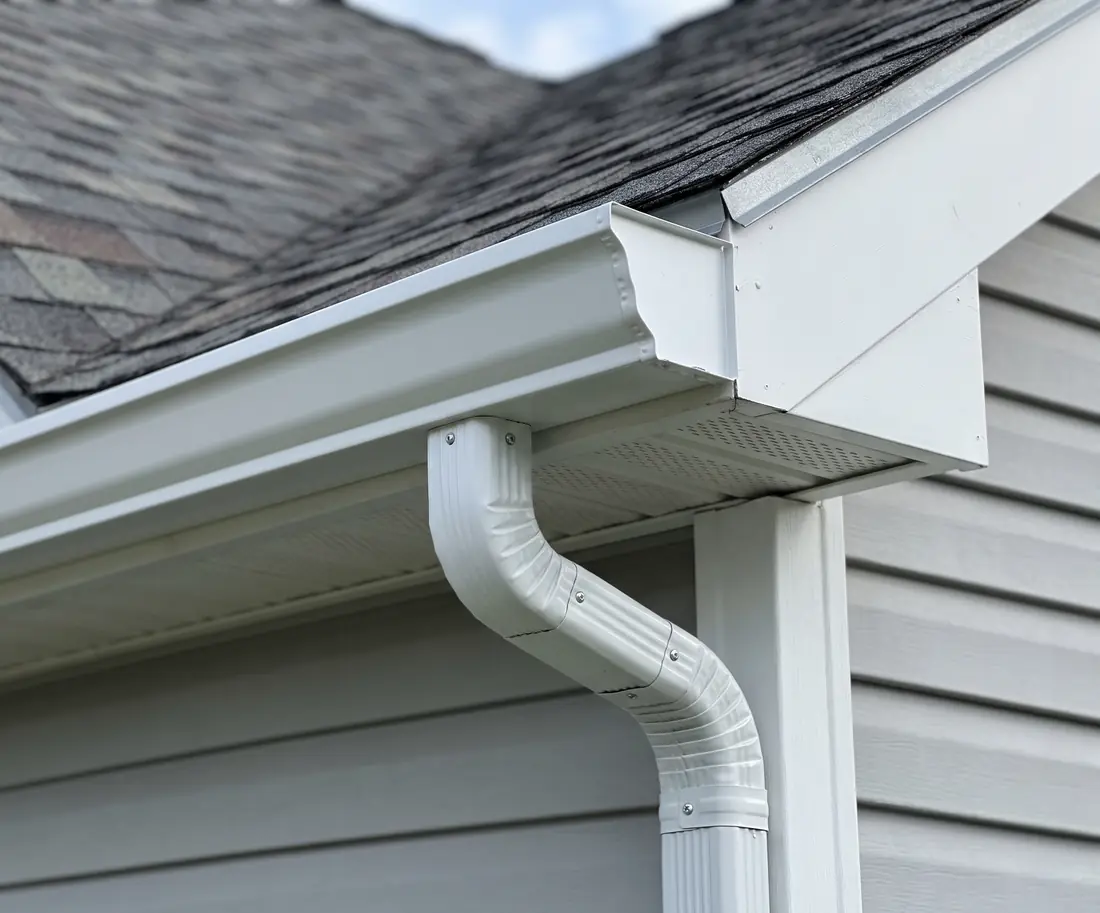
| Corners (miters) | Sealant breaks down; rivets loosen with movement |
| End caps | Crimp and sealant fail; standing water sits against them |
| Seams on sectional gutters | Every joint relies on sealant |
| Outlets | The drop is riveted in; sealant cracks |
| Holes and rust | Old steel, or old fastener holes left open |
| Behind the gutter | Missing drip edge, low gutter, back-side overflow |
Why do Decatur gutters leak?
Heat. Long, hot summers bake sealant until it hardens and cracks, while aluminum expands and contracts every day.
Standing water. Oak leaves and catkins dam the trough and hold water against joints for days.
Age. Many gutters on older houses have been patched over and over. Each layer of sealant smeared on top of the last makes the next repair harder.
Rain. The Atlanta normals on Wikipedia show rain in every month, so joints rarely get a long dry spell.
How is a leaking joint repaired properly?
- Wait for dry weather. Sealant won't bond to wet metal.
- Clean the joint back to bare metal, removing old sealant, dirt and oxidation.
- Re-rivet where the joint has loosened.
- Apply a gutter sealant made for the job, worked into the seam inside the trough.
- Check the slope so water doesn't sit against the joint.
What if water runs behind the gutter?
That usually means the roof edge needs a drip edge or gutter apron, the gutter is hung too low, or the gutter overflows at the back. Water behind the gutter soaks the fascia and soffit and, on older houses, the rafter tails. The fascia and soffit page covers the damage.
When do leaks mean replacement?
- Leaks at most joints around the house.
- Sectional gutters with seams every 10 feet.
- Rust, pinholes or very thin metal.
- Joints that have been resealed many times.
The repair or replace guide helps decide.
What can you check from the ground?
- After rain, look for drips at corners and end caps.
- Look for dark stains or peeling paint on the fascia below joints.
- Look for wet spots or washed-out soil below each corner.
- Check the soffit for brown water marks.
What does leak repair cost?
Leak repair is priced by the job. A single corner is a small job; resealing every joint on a two-story house is more. Ask for a written quote listing each joint and any wood repair.
Does a historic district change anything?
Resealing joints doesn't change how a house looks, so it rarely raises a question. If the repair turns into replacing a section with a different profile or material, ask the city first. See the historic districts guide.
What belongs in a written gutter quote?
- The gutter size and profile: 5-inch or 6-inch K-style, or half-round.
- The metal and its thickness, such as .032 aluminum, Galvalume steel or 16-ounce copper.
- The color, and whether the downspouts match the gutter or the wall.
- The hanger type, how far apart the hangers sit and what they screw into.
- How many downspouts, what size, where they go and where each one empties.
- Fascia, soffit or drip edge repairs, priced as their own lines.
- Taking down and hauling away the old gutters.
Two quotes that both name these items can be compared line by line. A single total with none of them tells you very little.
When is the best time to reseal?
Sealant needs a clean, dry surface to bond, so resealing is best done after a few dry days. Decatur rarely has a long dry season, but autumn often brings the steadiest dry spells, and October is usually the driest month by the Atlanta normals.
Which parts come up in a leak repair?
- Each joint to be cleaned, re-riveted and sealed.
- Any section to be replaced.
- Any drip edge to be added.
- Any wood repair behind the leak.
Can a leak be temporary?
Yes. A joint can drip only when debris dams water against it. Clearing the gutter sometimes stops the drip, though the joint should still be checked.
How do you check a gutter contractor in Georgia?
Start with the state rules. Georgia's State Licensing Board for Residential and General Contractors requires a license for residential work worth more than $2,500, though some specialty work falls outside it, so ask the contractor which rule covers your job and check any license number on the Secretary of State's verification lookup. Ask for proof of liability coverage and the addresses of a few recent jobs in Decatur or elsewhere in DeKalb County. Get a written quote that names the gutter size, metal and thickness, color, hanger type and spacing, the number and size of downspouts, where each one drains, and who hauls the old gutters away. If the house sits in one of Decatur's five local historic districts, exterior work generally needs a Certificate of Appropriateness from the Historic Preservation Commission before a building permit is issued, so ask whether the job needs one before a date is set.